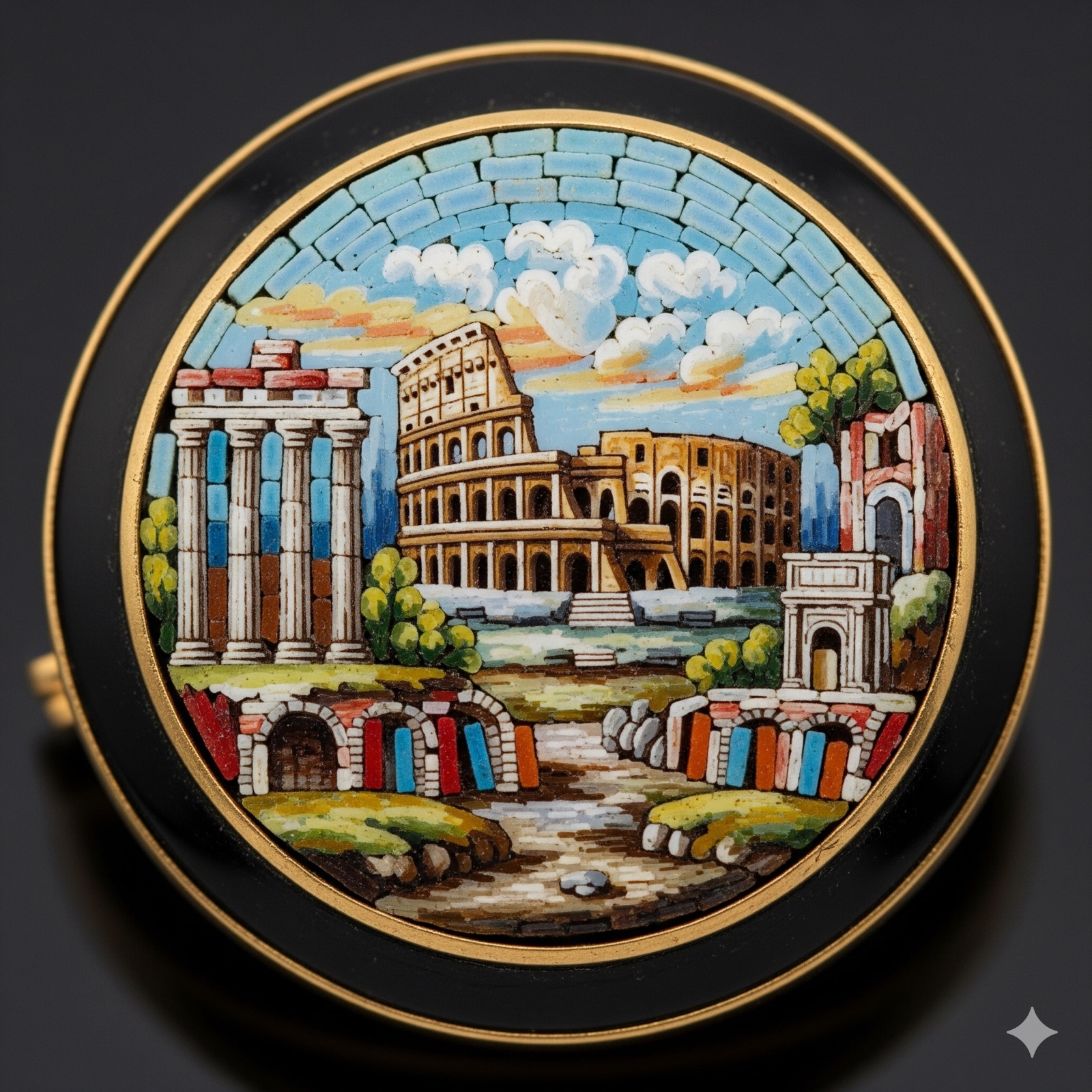
In the world of antique jewelry, there is a craft that exists specifically for “Showing Off Skills”, that is Micro Mosaic.
When you first see it, you might think it is micro-painted Enamel. But when you pick up a 10x magnifying glass, you will be shocked to find: it is not drawn by a brush, but collaged by hundreds or thousands of tiny colored glass pieces (Tesserae)!
🏛️ Top Souvenir of the Grand Tour
In the 18th and 19th centuries, it was popular for noble children in Britain and Northern Europe to go on a “Grand Tour”, and Italy was a must-visit place.
In order to bring the scenery of the Roman Colosseum, St. Peter’s Basilica or the Vatican home, Roman craftsmen invented micro mosaics. This kind of jewelry is not only decoration, but also proof of identity of “I have been to Italy”.
🔬 Craft Analysis: Pulling Glass into Silk
- Smalti: Craftsmen first heat and melt opaque colored glass, pull it into extremely thin strips (Filati), some even thinner than hair.
- Slicing and Collaging: Cut these glass threads into tiny particles, fill them into metal or black glass bases bit by bit with tweezers, and spell out flowers, landscapes or animal patterns.
- Polishing: Finally, polish the surface smooth and wax it to make it look like a flat oil painting.
🔍 Collection Guide: Counting “Pixels”
There is only one core standard for judging the value of micro mosaics: Fineness.
1. Look at Particle Size
Early (1800-1850) works may contain 3000-5000 glass particles per square inch. Under this fineness, the naked eye can hardly see the splicing gaps. Later tourist souvenirs (1900s) have larger particles and rougher craftsmanship.
2. Look at Subject
- Scenery: Most expensive. Especially Roman ruins, St. Peter’s Square.
- Animals: Extremely popular. Such as King Charles Spaniel or Pliny’s Doves.
- Floral: Most common, also the first choice for entry.
3. Look at Completeness
This is a fatal injury. Because the particles are too small, they fall off easily after a hundred years of wear. Missing Tesserae will seriously affect the value. When buying, be sure to check with a magnifying glass for black holes or traces of repair.
Owning a top-tier micro mosaic is like wearing the entire Rome on your chest.