When mentioning pearls, it is difficult to bypass Japan; when mentioning Japanese pearls, it is difficult to bypass the word “Showa”.
In Rarequiste’s treasure hunting journey, R is often impressed by those decades-old pearls in Japanese vintage markets. They are often not as large as modern pearls, but that sharp luster like a “Small Light Bulb”, and the warm feeling after years of precipitation, are incomparable to modern instant pearls.
Today, let’s talk about the charm of Japanese vintage pearls and how to identify those legendary brand marks.
🕰️ Why buy “Old Pearls” in this era?
Many people will have questions: Aren’t pearls better when they are newer? After all, pearls are organic gems and will age. But in the world of Japanese Akoya pearls, “old pearls” often mean thicker nacre (Nacre Thickness).
⏳ Secret of Cultivation Time
- Showa Era: Cultivation at that time pursued quality rather than speed. Pearl oysters were usually cultivated in the sea for 1.5 years or even more than 2 years. This means the nacre is very thick (usually above 0.4mm - 0.6mm), with deep luster and charming Overtones.
- Modern Commercial Cultivation: In order to pursue output, many Akoya pearls are harvested after only 6-8 months of cultivation. Although bright, the nacre is thin, and the luster appears “floating” and “brittle”, and it is easy to peel off after wearing for a long time.
Therefore, picking up a well-preserved Showa era Akoya is essentially collecting that era of “sparing no expense”.
🏷️ Identifying Brand Marks: Mikimoto and Tasaki
In the Japanese vintage market, even without a certificate, as long as you see specific metal hallmarks, the price and collection value will double immediately.
1. Mikimoto: King of Pearls
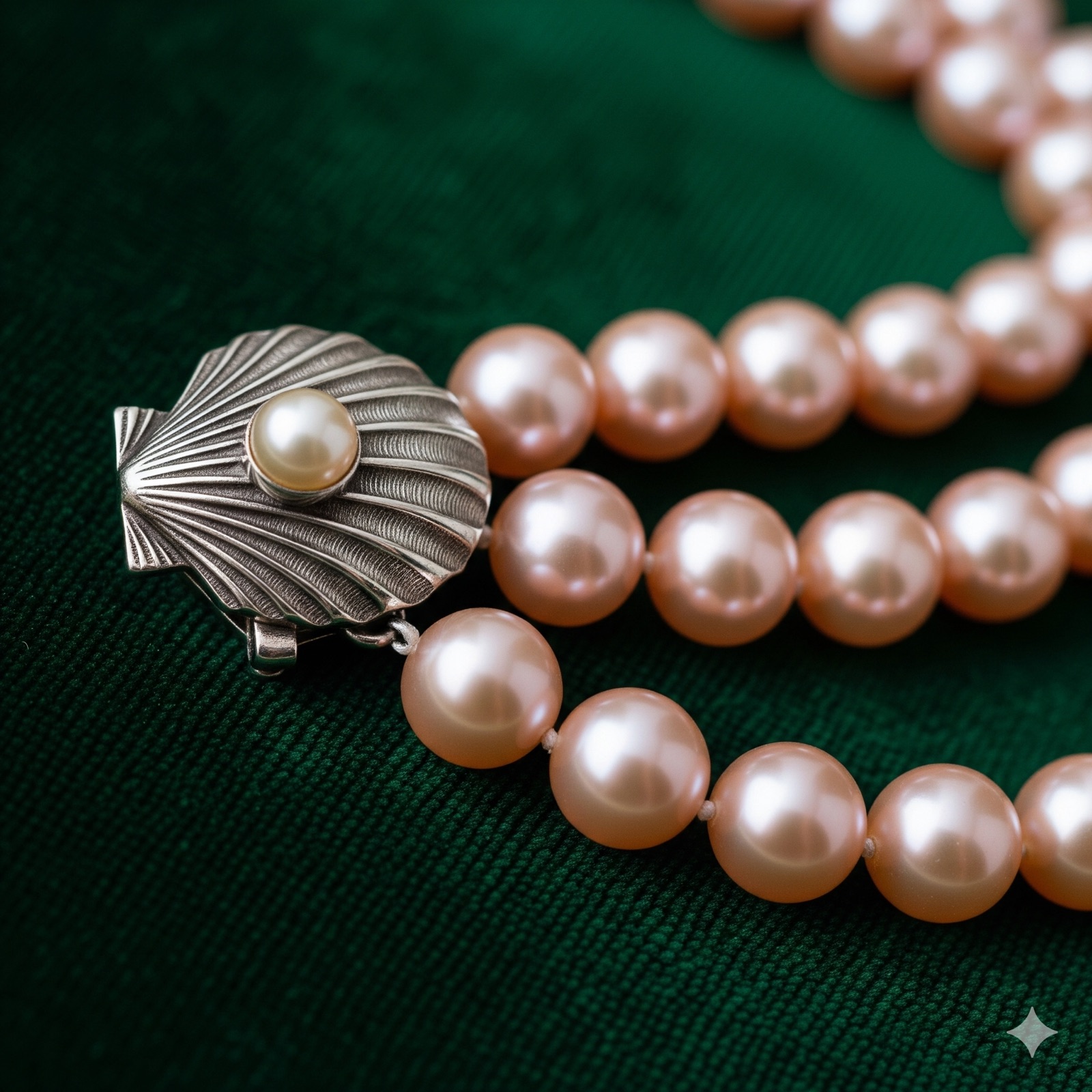
Mikimoto is the originator of cultured pearls. In vintage jewelry, its clasp is usually made of silver.
- The Shell M: This is the most classic logo. Inside a shell-like or semi-circular outline, wraps a letter M.
- Sterling Silver Mark: Usually accompanied by
S,Sterling, orSilver. - K Gold Mark: If it is a gold clasp, it will be stamped with
K14orK18. Note that old Japanese gold often uses the writing method of K18 (K in front), while Europe often uses 18K (K in back) or 750.
2. Tasaki: Low-key Giant
Tasaki’s designs are often more modern and bolder than Mikimoto.
- Old Shell Mark: Tasaki’s early logo was also a shell shape, but the pattern inside looked more like a fan, or like a fingerprint.
- Triangle Mark: Modern Tasaki uses a spire-like triangle logo, but transitional designs can also be seen on vintage models from the 80s and 90s.
🔩 Unique Material: SPM (Sun Platinum Metal)
When you hunt for old Japanese pearl rings or belt buckles, you will often see a mysterious engraving: SPM.
This is not silver, nor platinum, but “Sun Platinum Metal”.
This is a nickel-chromium alloy unique to Japan, invented in the 1930s.
- Features: Its luster is very similar to Platinum, and it is extremely resistant to oxidation and discoloration.
- Value: Although it is not a precious metal, it is a unique product of the Showa era. Many high-quality early works of Mikimoto used SPM as a setting because it was more durable than silver at that time.
🔍 R’s Practical Experience: How to select condition?
Pearls are delicate. When buying vintage pearls, be sure to check the following three points:
- Luster: This is the soul of the pearl. Put the pearl in the shade, see if it can still reflect sharp light and shadow? If it is as dull as chalk, it means the nacre has seriously aged, don’t buy it.
- Surface: Check if there is peeling near the pearl hole. If the nacre peels off and reveals the bead nucleus inside, it is a “dead pearl”.
- String: Old pearl necklaces usually use cotton thread. If the thread is very loose and the gap between pearls is large when picked up, it needs Restringing after buying back. This is normal and also a good reason for bargaining.
📝 Summary
A Mikimoto silver clasp necklace from the 1970s, paired with a simple white shirt, that elegant “Showa Retro” style is unique.
At Rarequiste, we are looking for not just jewelry, but the craftsman spirit of “Isshokenmei” (devoting one’s life) to making products.