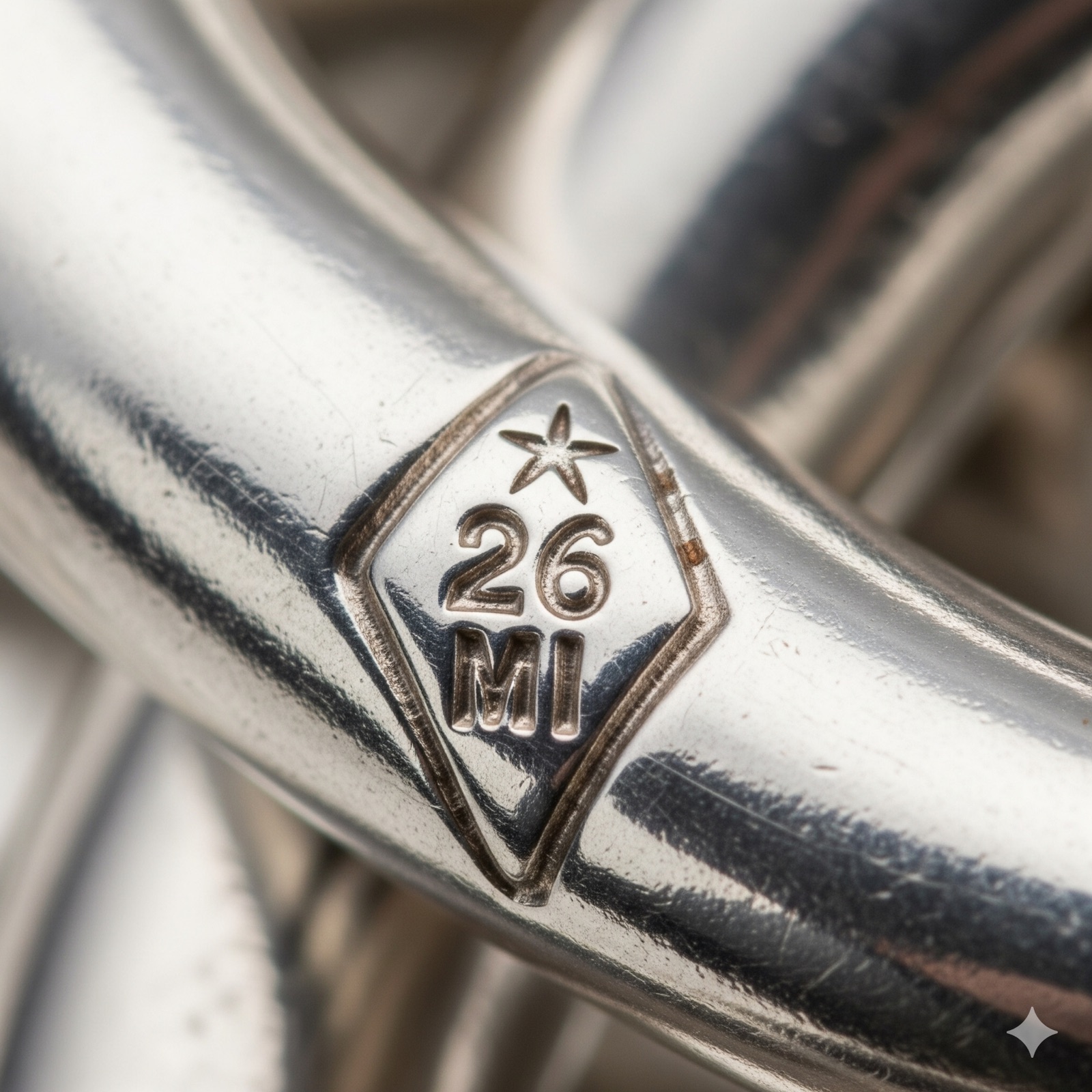
In Rarequiste’s inbox, friends often send a blurry photo asking: “There is a pentagram in this hallmark, which country is it from?”
The answer is usually: Modern Italy.
The Italian silver hallmark system has undergone three major changes. Understanding these three stages, you can easily date them.
🪓 Stage 1: Fascist Period (1934 - 1944)
This is the darkest and rarest period in history. The Mussolini government mandated the inclusion of the Fascist party symbol—Fasces—in silver hallmarks.
- Mark Features: A lozenge frame containing purity (such as 800), province abbreviation (such as MI for Milan), and a tiny axe fasces pattern.
- Collection Value: Although this history is not glorious, silver items with fasces marks are very rare (many were destroyed or re-marked after the war), so they have high historical documentary value.
🚫 Stage 2: Post-war No Star (1944 - 1968)
After World War II, the fasces was removed.
- Mark Features: Still a lozenge frame, but only containing the craftsman number and province abbreviation.
- Key Point: No pentagram.
- Example:
123 MI(representing the 123rd silversmith registered in Milan).
⭐ Stage 3: Modern Star Mark (1968 to Present)
This is the mark you most commonly see on big brands like Gucci, Buccellati.
- Mark Features: A Pentagram (☆) is added to the far left of the lozenge frame.
- Format:
☆ Craftsman Number Province Abbreviation. - Example:
☆ 1750 AR(The 1750th silversmith in Arezzo province).
🗺️ Geographical Code: What do those letters represent?
Italy has several famous gold and silver processing centers, recognize these abbreviations:
- MI (Milano): Milan. The birthplace of Buccellati, gorgeous style, specializing in textured gold carving.
- VI (Vicenza): Vicenza. Italy’s “City of Gold”, most K gold chains come from here.
- FI (Firenze): Florence. Specializing in Renaissance style hand chiseling.
- AL (Alessandria): Alessandria. Many foundries for Bulgari are here.
- AR (Arezzo): Arezzo. The main production area of modern mechanical chains.
⚖️ Purity: 800 vs 925
- 800: The absolute mainstream of Italian old silverware (hollowware). If you buy a silver plate or silver bowl, it is usually 800.
- 925: Mainly used for modern jewelry and export goods.
Summary: Look for stars.
- No Star = Before 1968 (Old).
- With Star = After 1968 (Modern).
- With Axe = 1934-1944 (Special historical period).