If the “Lion Passant” is the ID card of British silver, then the “Town Mark” is its birth certificate.
In today’s market, 90% of antique silver comes from the four “Big Cities” that survive today: London, Birmingham, Sheffield, and Edinburgh.
However, for the advanced collector, the real thrill lies in hunting for the “Lost Cities”—those Provincial Assay Offices that closed due to historical shifts, wars, or economic depressions.
When you spot three wheat sheaves instead of a leopard’s head on an unassuming spoon, you may have just bought a rare piece of Chester silver for the price of common ware.
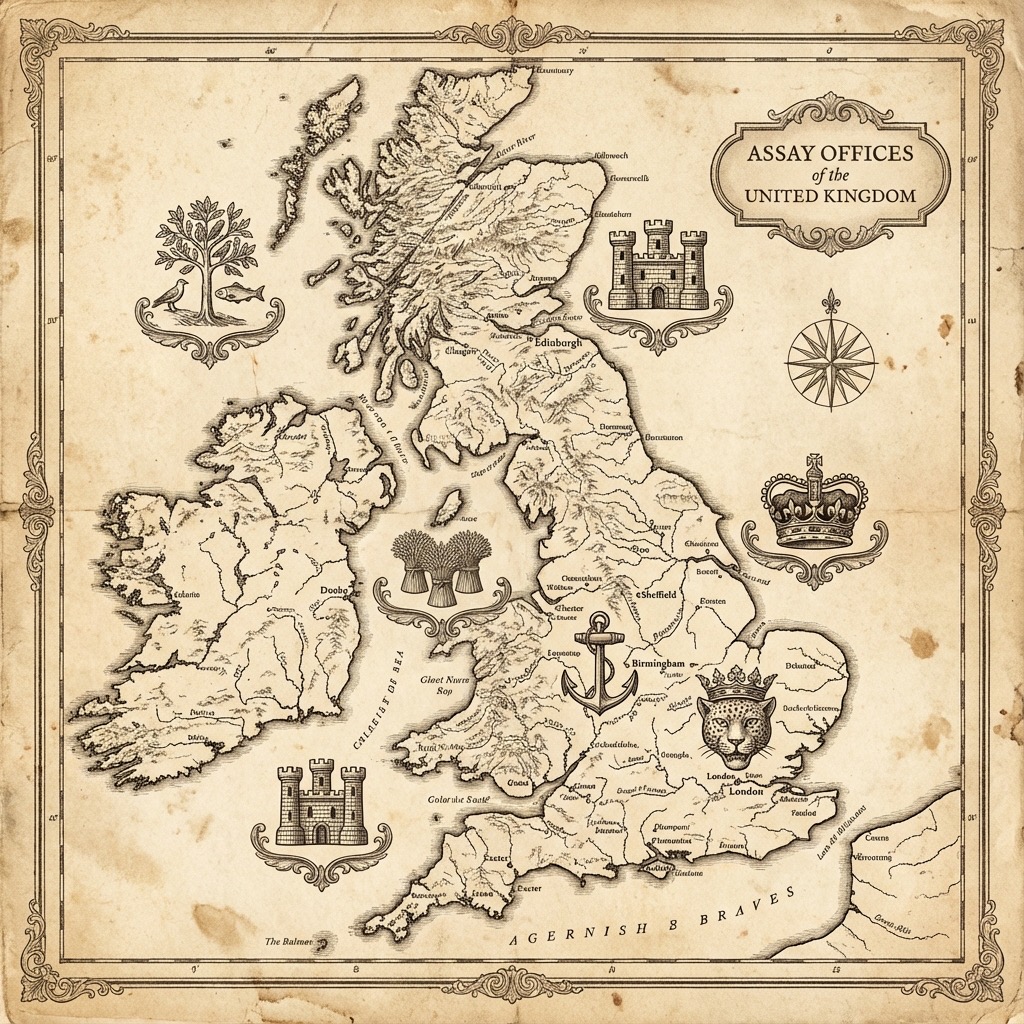
Today, Q unfolds this complete map of British silver marks for you.
📍 The Survivors (The Big Four)
These four are still operational and possess the most common marks.
1. London - 🐆 Leopard’s Head


- Status: The Boss. Operational since 1300.
- Evolution:
- Pre-1822: The Leopard’s Head was Crowned.
- Post-1822: The crown was removed, becoming the Uncrowned Leopard’s Head we see today.
- Trivia: The early “Leopard’s Head” was actually a Lion’s face, as in heraldry, a “Leopard” referred to a lion passant guardant (facing the viewer).
2. Birmingham - ⚓️ Anchor

- Status: A product of the Industrial Revolution, established in 1773. Huge production volume.
- Identity: Famous for small silverware (snuff boxes, card cases, jewelry).
- Myth: Why use an Anchor for an inland city? Because the delegation lobbying for the assay office met at the “Crown & Anchor Tavern” in London. Sheffield got the Crown; Birmingham got the Anchor. No maritime connection whatsoever.
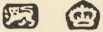
3. Sheffield - 👑 Crown / 🌹 Rose
- Status: A silver stronghold, established in 1773.
- Evolution:
- Pre-1975: The Crown.
- Post-1975: The Yorkshire Rose.
- Note: If you see a Crown, don’t mistake it for a Royal Warrant. It simply means made in Sheffield. Also, the Crown mark was strictly forbidden on silver plate.
4. Edinburgh - 🏰 Castle

- Status: Capital of Scotland. Established 1485.
- Identity: A three-towered castle. Scottish silver is generally heavier and more rugged (Celtic style) than English silver.
- Special: Besides the Lion Rampant (or sometimes Passant), Scottish standard marks often use the Thistle.
🗺️ The Lost Offices (The Provincial Treasures)
This is a treasure map. If you see these marks, take a second look.
1. Chester - 🌾 Three Wheat Sheaves

- Active: 1701 - 1962 (Closed).
- Mark: A sword erect between three wheat sheaves (garbs).
- Collectibility: ⭐⭐⭐⭐⭐
- Comment: Chester silver is one of the most sought-after “Provincial Marks” today. Much of it wasn’t made in Chester but sent there (often from Birmingham) for assaying, yet this provenance commands a high premium.
2. Exeter - 🏰 Three Towered Castle
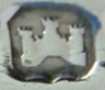
- Active: 1701 - 1883 (Closed).
- Mark: Similar to Edinburgh but usually broader, and the castle has no flags on the towers.
- Collectibility: ⭐⭐⭐⭐
- Comment: Famous for exquisite Georgian table silver, especially Exeter Spoons. The West Country silversmithing of that era was superb.
3. Newcastle - 🏰 Three Separate Castles

- Active: 1702 - 1884 (Closed).
- Mark: Three separate castle shields (two above, one below).
- Collectibility: ⭐⭐⭐⭐
- Comment: The representative of Northern silver. Newcastle silver is often heavy, practical, and carries the sturdy vibe of an industrial city.
4. Glasgow - 🌳🐟🐦🔔 Tree, Fish, Bird & Bell

- Active: 1819 - 1964 (Closed).
- Mark: The most complex, pictorial mark of all. Based on the Glasgow city crest: a tree, a bird on top, a fish with a ring in its mouth below, and a hanging bell.
- Collectibility: ⭐⭐⭐⭐
- Comment: Part of the Scottish system, often using the Thistle mark. Glasgow School silver from the Arts & Crafts period is historically significant.
5. York - ✝️ Five Lions on a Cross

- Active: 1400s - 1856 (Closed).
- Mark: A cross charged with five lions passant.
- Collectibility: ⭐⭐⭐⭐⭐ (Extremely Rare)
- Comment: Easily misinterpreted. If you truly find a piece of York silver, it is likely an auction-grade rarity.
📝 Summary: Hunting Cheat Sheet
| Mark Feature | City | Status | Rarity |
|---|---|---|---|
| 🐆 Leopard | London | ✅ Active | Common |
| ⚓️ Anchor | Birmingham | ✅ Active | Common |
| 👑 Crown | Sheffield | ✅ Active(Old) | Common |
| 🌹 Rose | Sheffield | ✅ Active(New) | Common |
| 🏰 Castle(Flags) | Edinburgh | ✅ Active | High |
| 🌾 Wheat Sheaves | Chester | ❌ Closed 1962 | Hot |
| 🏰 Broad Castle | Exeter | ❌ Closed 1883 | High |
| 🏰 Three Castles | Newcastle | ❌ Closed 1884 | High |
| 🌳🐟 Tree/Fish | Glasgow | ❌ Closed 1964 | High |
Next time you pull out your loupe, don’t just look for the lion. Look for that sheaf of wheat, or that tree with the bird. That’s where the hidden value lies.
📚 References
- SilverCollection.it - ENGLISH, SCOTTISH AND IRISH SILVER HALLMARKS - BIRMINGHAM SILVER DATE LETTERS AND SYMBOLS - THE GUIDE TO MARKS OF BRITISH SILVER - LONDON -
- SilverCollection.it - ENGLISH, SCOTTISH AND IRISH SILVER HALLMARKS - BIRMINGHAM SILVER DATE LETTERS AND SYMBOLS - THE GUIDE TO MARKS OF BRITISH SILVER - BIRMINGHAM -
🇬🇧 British Silver Series
- The Basics: British Silver Hallmarks: Decoding the 700-Year-Old System
- The Map (You are here): The Lost Cities of Silver: A Guide to British Assay Offices
- The Timeline: The Da Vinci Code: How to Date British Silver in Seconds?