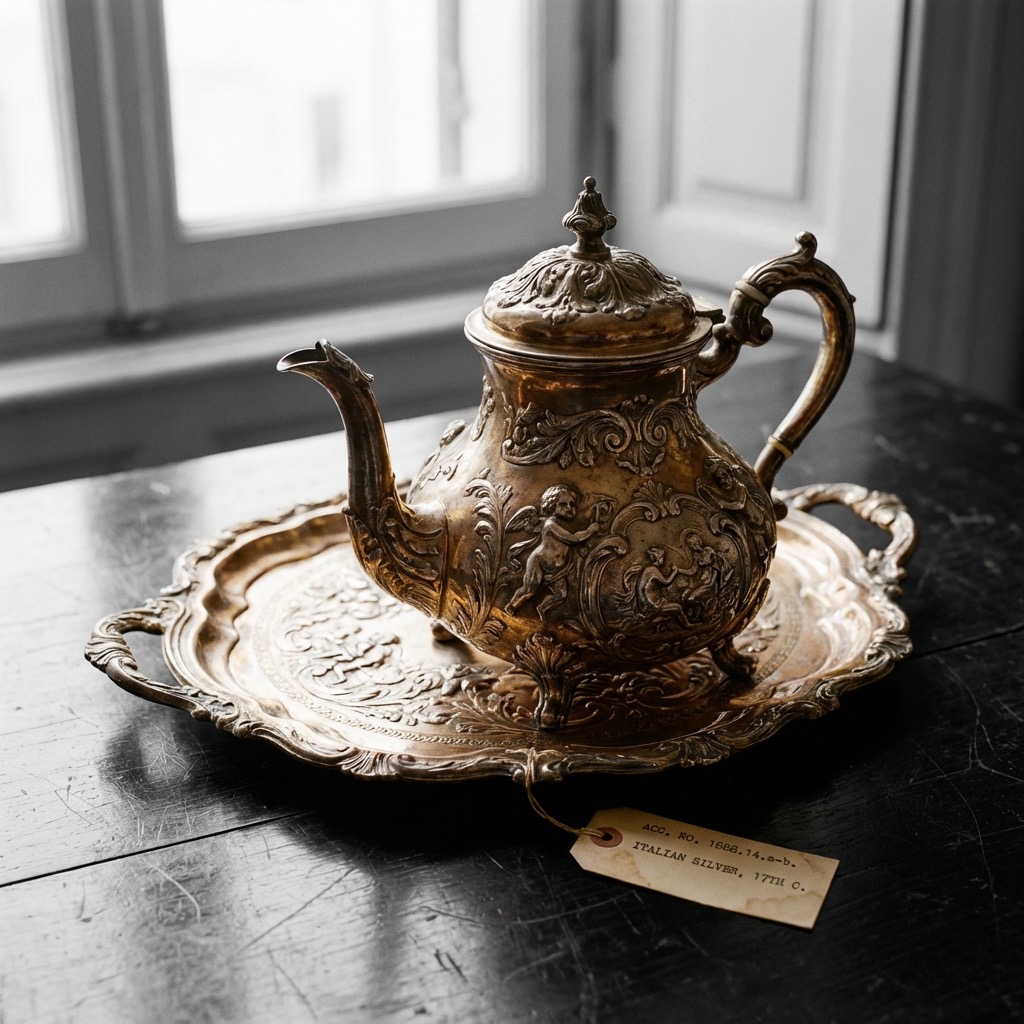
In the world of silver collecting, there is a concept that often confuses beginners: “Bleeding.”
Usually, when you see the surface of a silver piece worn away to reveal a base metal underneath, the immediate reaction is: “This is cheap electroplate, it’s worthless.”
But in one specific case, this “wear” is not a flaw, but a badge of authenticity. This is the subject of our discussion today—Old Sheffield Plate (OSP).
What is Old Sheffield Plate?
Old Sheffield Plate was born in 1743 and is a long-lost physical fusion process.
Its invention was entirely accidental. Thomas Boulsover, a cutler in Sheffield, was repairing a knife handle when he accidentally overheated silver and copper together. He was amazed to find that the two metals fused so tightly that no matter how much he hammered or rolled them, the silver layer adhered to the copper core like skin.
This gave birth to the core technology of OSP: Silver Fused on Copper.
This is fundamentally different from Electroplate (EPNS), which was invented in 1840 and later dominated the market:
- OSP: Physical fusion, thick silver layer, warm feel.
- EPNS: Chemical electrolysis, thin silver layer, cold shine.
Three Keys to Identifying OSP
OSP only existed between 1743 and 1840 (after which it was replaced by cheaper electroplating). As a product of the Georgian era, a well-preserved piece of OSP can be more collectible than solid silver of the same period.
Here are three core features to identify it:
1. The Bleeding
This is the most fascinating and intuitive feature of OSP.
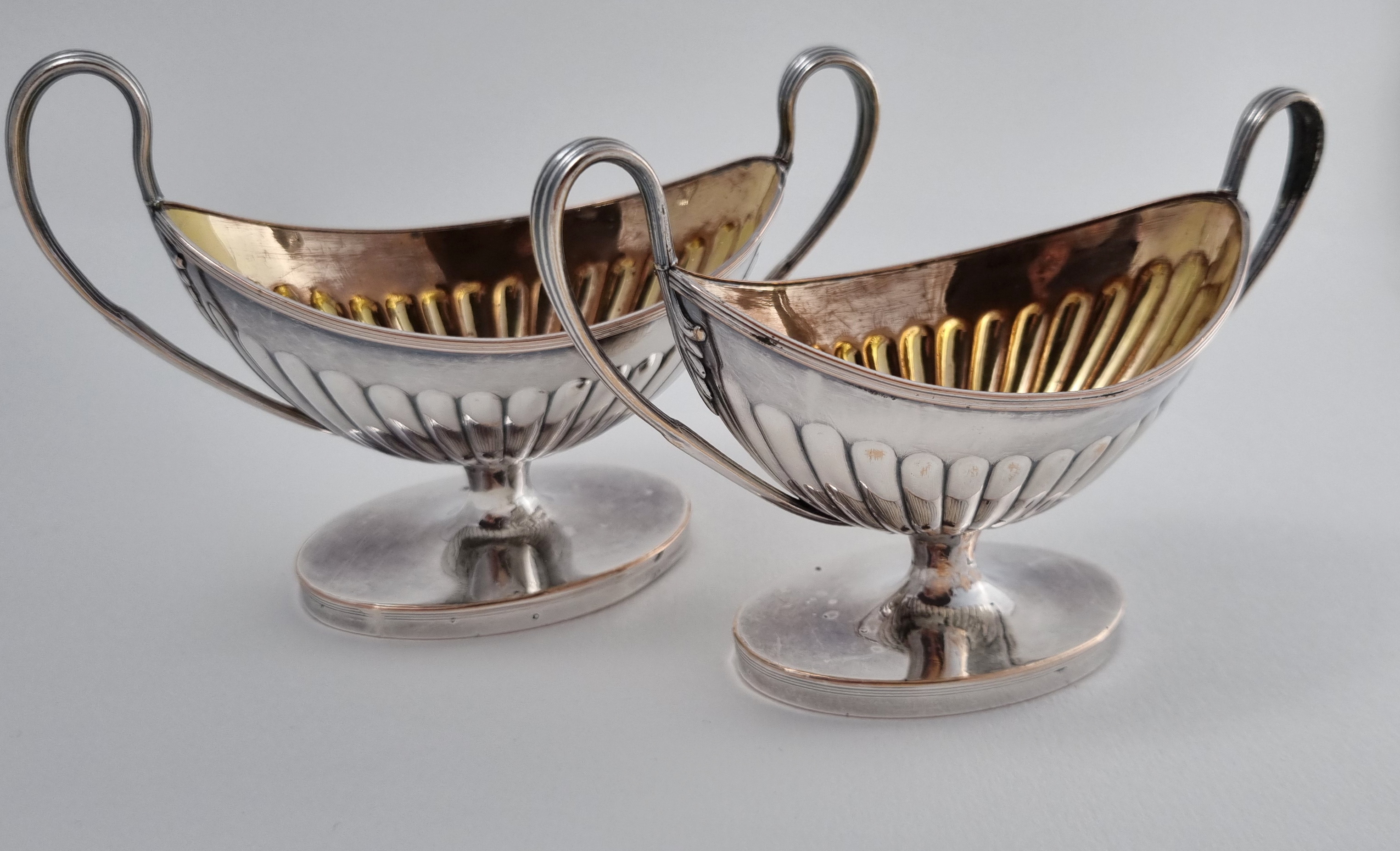
Due to years of polishing, the silver on the high points or relief edges of an OSP piece gets worn away, revealing the red copper underneath. This natural transition between silver and copper, a reddish hue glowing through the white, is called “Bleeding.”


To connoisseurs, this “bleeding” is considered a desirable Patina. It proves that the object has survived over 200 years of history, rather than being a modern replica.
2. Turned-over Edges
Because OSP is a “Silver-Copper-Silver” sandwich, if you cut it, the raw edge would show a copper line. To hide this unsightly line, craftsmen invented the clever Turned-over Edge technique.
They would hammer the top layer of silver thinner, extend it out, and then roll it under to cover the copper edge. If you run your fingernail gently under the rim of a plate, you can often feel a slight Lip or seam. This is a tell-tale sign of genuine OSP.
3. Silver Shield Inset
This was perhaps the smartest invention of the OSP era.
Nobles of the time loved to engrave their monograms on silverware. But since OSP is plated, engraving would cut right through to the copper, which looked terrible.
The solution? Craftsmen would cut out a small piece of the surface layer at a specific spot (usually the center or handle) and inset a solid piece of sterling silver. They would then polish it flush so it looked seamless.
If you look closely at an OSP pot against the light, you might see a faint circular or shield-shaped “Ghost Patch” (due to the slight color difference in silver grades). That is the solid silver “patch” meant for engraving. It is irrefutable proof of OSP.
Collection Value
Although OSP was originally invented as “Poor Man’s Silver,” high-quality OSP today commands serious prices.
A finely crafted candlestick by Matthew Boulton (the most famous OSP maker, known for his “Double Sun” mark) can easily fetch thousands of dollars.
So next time you’re in an antique shop, don’t dismiss that old plate with the reddish copper showing through as junk. That warm glow is the lingering light of the early Industrial Revolution, from over 200 years ago.
Curious? If you find your silver is not ‘fused’ but ‘plated’, check out our new guide: Decoding Silver Plate: How to Read EPNS, EPBM, and Pseudo Hallmarks
References:
- Crosskey, Gordon. “Old Sheffield Plate: A History of the 18th Century Plated Trade”
- Old Sheffield Plate (Wikipedia)