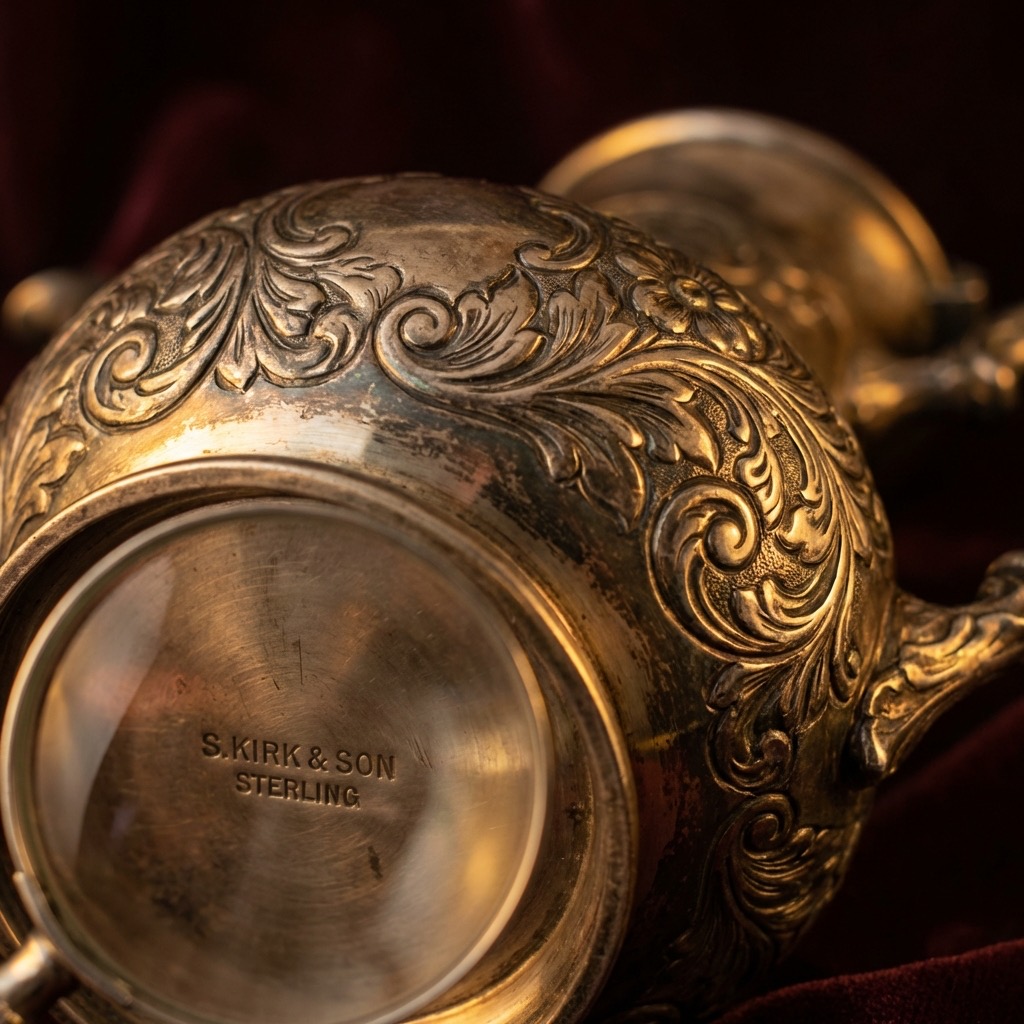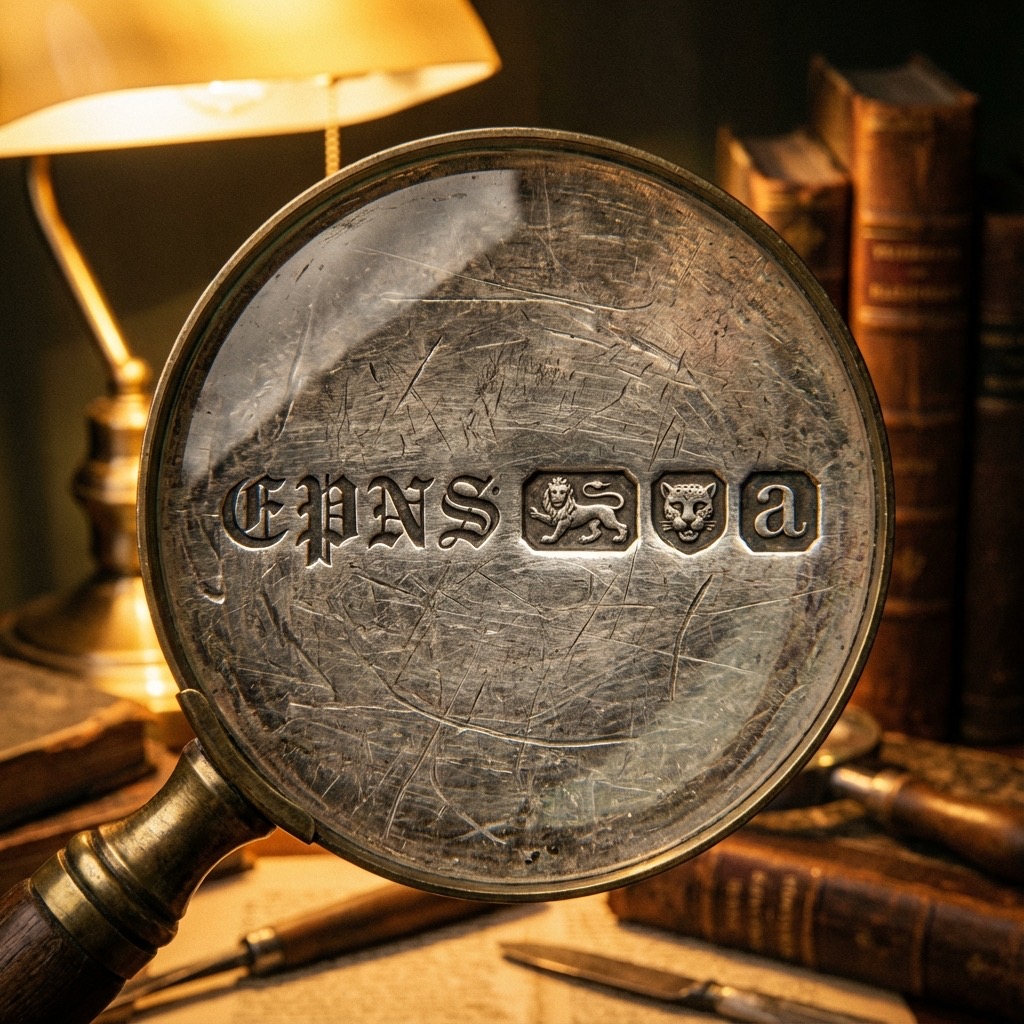
In the world of antiques, especially with British silverware, you’ll often encounter a confusing scenario: an item stamped with various marks that look very “official”—lions, crowns, letters—yet priced at a fraction of sterling silver.
The seller might tell you, “It’s silver plate.”
If you look closely, you’ll notice these marks, while intricate, don’t appear in any standard sterling hallmark guidebook. This is the “open secret” of the 19th-century British electroplating industry: to satisfy the aspirations of the rising middle class, silver plate manufacturers intentionally imitated the style of sterling silver hallmarks.
But this doesn’t mean silver plate lacks collectible value or is impossible to identify. By decoding these marks, you can uncover its material, quality, and even the maker.
1. The Core Material Codes: EPNS vs. EPBM
This is the first and most crucial step. The two most common acronyms you’ll see are EPNS and EPBM.
EPNS (Electro Plated Nickel Silver)

- Meaning: Electro Plated Nickel Silver.
- Composition: The base metal is an alloy of nickel, copper, and zinc (Nickel Silver), plated with pure silver.
- Characteristics: Nickel silver itself is silvery-white and extremely hard. Even if the silver plating wears off, the exposed base metal is a pale, yellowish-white that blends well. This is the mark of high-quality silver plate.
EPBM (Electro Plated Britannia Metal)

- Meaning: Electro Plated Britannia Metal.
- Composition: The base metal is an alloy of tin, antimony, and copper (Britannia Metal, similar to pewter), plated with pure silver.
- Characteristics: The base metal is a dark dull grey and is softer. Worn areas will reveal ugly dark grey patches. Generally, these items are considered lower value than EPNS.
Other Common Abbreviations
- EP (Electro Plated): Simple identification for generic plating.
- BP (Britannia Plate): Same as EPBM.
- EP ON COPPER: Plated on copper. This mimics the earlier “Old Sheffield Plate”. When worn, the red copper shows through, creating what some consider a desirable “bleeding” effect.
- A1 / AI: This indicates Quality, not material. It stands for “Superior” or First Class. Lower grades follow as A, B, C, D.
2. The Maker’s Masquerade (Pseudo Hallmarks)
This is the trickiest part. To make plated ware look like expensive sterling, makers used “Pseudo Hallmarks”.
Common Tactics:
- Imitating Frames: Placing letters inside individual shields, circles, or squares to resemble the “Lion Passant” or “Leopard’s Head” of sterling.
- Gothic Script: Using old-fashioned Gothic letters to add a sense of history.
- Misleading Symbols:
- S: In plated ware, this often stands for Sheffield or Sons (as in ”& Sons”), whereas in sterling, it is part of the date letter system.
- Crown/Fleur-de-lys: While these have specific meanings in sterling hallmarks (like the Sheffield Assay Office mark), on plated ware, they are often just decorative symbols.
Famous Example
Take the renowned maker Barker Brothers. They used a “Three Stars in a Shamrock” symbol, often accompanied by B.B. Without knowledge, one might mistake it for a mysterious family crest.
3. The Number Trap: Is it a Date?
On the bottom of many plated teapots or trays, you’ll see a four-digit number, like 8421 or 2845.
A common beginner mistake is assuming this is the year (e.g., 1842).
The Truth: In 99% of cases, this is a Pattern Number or Stock Number. It allowed retailers to reorder specific designs from the manufacturer’s catalog. While it can help you find the production period if you have the catalog, it is absolutely not the year of manufacture.
Note: Only a few top-tier makers (like Elkington & Co.) used a specific letter code system to date their pieces, but this is the exception, not the rule.
4. Summary: The 5-Step ID Process
Next time you spot a piece of “mystery silver” at a flea market, try this sequence:
- Find EPNS/EPBM: Identify the base. EPNS > EPBM.
- Check Quality: Is there an A1 mark? That’s a bonus.
- Inspect Wear: Do you see Copper (Red) or Pewter (Grey)? Nickel (White) is best.
- Read the Letters: Try to decipher Gothic initials.
J.D & Sis James Deakin & Sons;M & Wis Mappin & Webb. - Ignore the Random Numbers: Unless you have the original catalog, it’s just a model number.
Even if it’s “just” silver plate, a well-made Victorian EPNS piece often holds more aesthetic and historical value than a modern mass-produced sterling item.
Reference: SilverCollection.it - Decrypting Silver Plate Marks