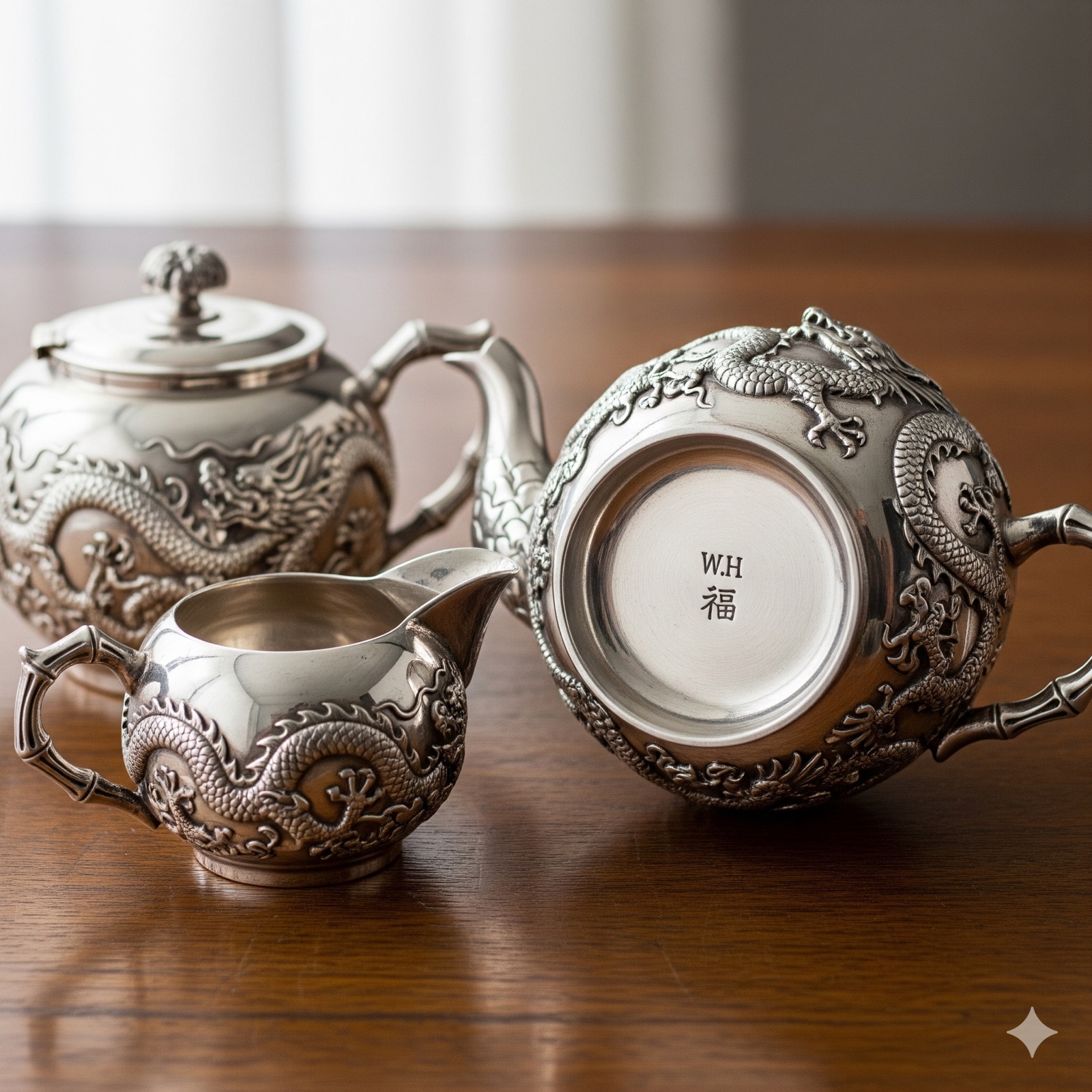
In a corner of the Mercatone dell’Antiquariato in Milan, Q once discovered a strange silver teapot. Its shape was typical British shell pattern, but the body was engraved with lively “Dao Ma Ren” (Peking Opera martial arts figures) and coiling five-clawed dragons.
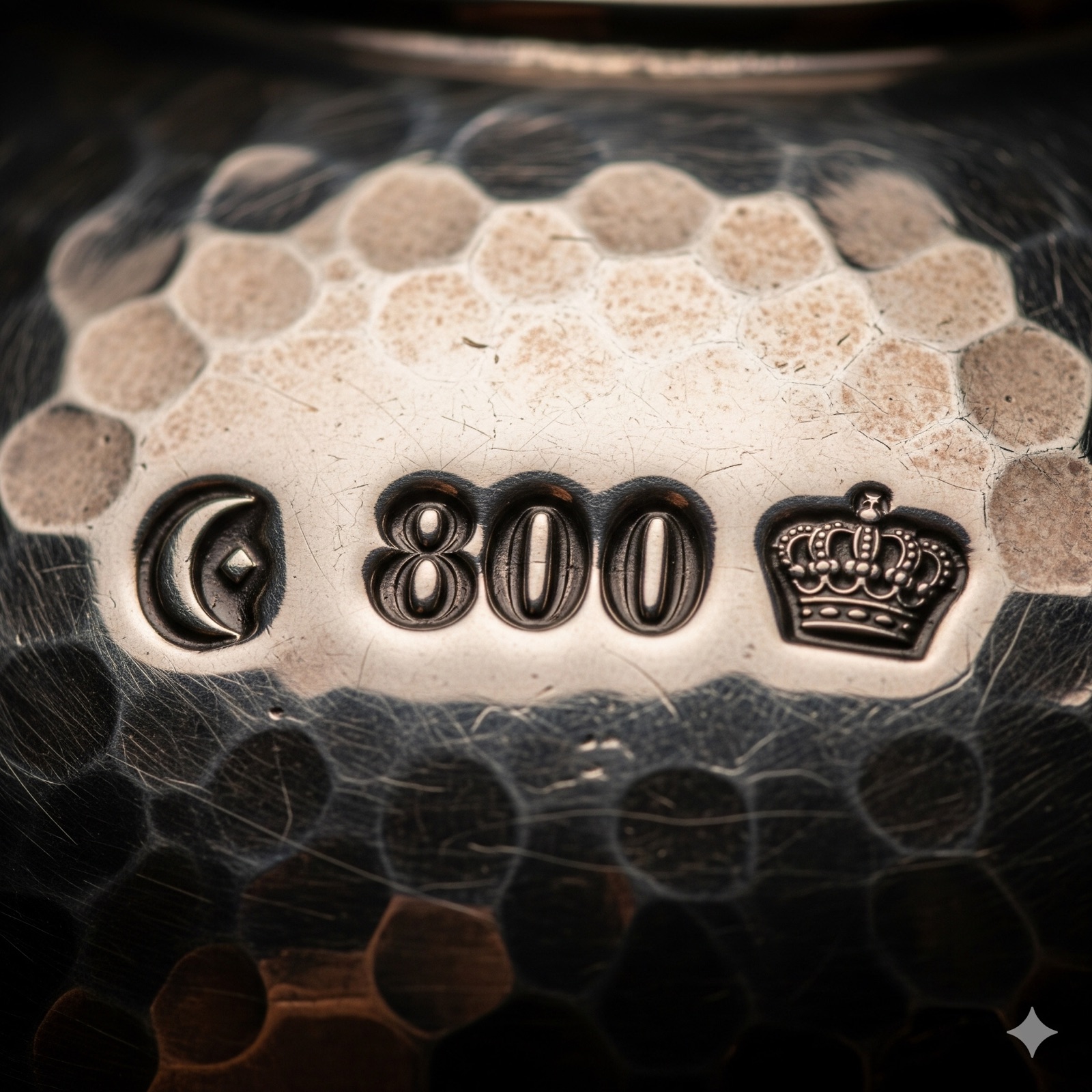
Turning to the bottom, the hallmark was not a lion, but an English abbreviation WH accompanied by a Chinese character stamp “Fa”.
This is Chinese Export Silver (CES).
🌏 What is Export Silver?
From the 18th century to the early 20th century (Qianlong to Republic of China), silver items made specifically for the Western market by Chinese silversmiths. These silver items usually adopt Western shapes (such as coffee pots, mugs, card cases), but the decorative craftsmanship is pure Chinese technique.
They are witnesses to the history of East-West trade and were long mistaken for Western silverware until they were independently classified for collection in recent decades.
🏢 Famous Retailers
The hallmark system of export silver is very chaotic, but recognizing a few big retailers is usually not wrong:
-
Wang Hing: Mark
WH. The “half the sky” of the export silver world. Wang Hing was mainly active in Guangdong and Hong Kong, famous for high-quality reticulated dragon patterns and bamboo knot patterns. If you are a novice, buying WH is absolutely right. -
Luen Wo: Mark
LW. A silver house active in Shanghai. Compared with Guangdong work, Shanghai Style is more delicate and realistic, often featuring character story scenes. -
Tuck Chang: Mark
TC. Also a Shanghai merchant, famous for heavy materials and deep relief (Repoussé).
💎 Why is it worth collecting?
- Swan Song of Craftsmanship: Export silver extensively used Repoussé, openwork, and filigree enamel techniques. In that era without 3D printing, hammering out hundreds of characters with different expressions on a silver plate, this craft is now almost lost.
- Price Depression: Compared with British silverware of the same era (such as Paul Storr’s works), exquisite Chinese export silver is currently still undervalued, but the increase is amazing.
⚠️ Identification Minefield: Fake “Lions”
Early (before 1840) export silver, in order to cater to Western buyers, sometimes stamped Pseudo-Hallmarks. Craftsmen would imitate British lion marks and leopard head marks, but drew them speciously (for example, the lion looks like a dog, the leopard head looks like a cat).
If you see a row of marks that look very much like British marks but are somewhat comical, don’t rush to put it down, it may be earlier Qianlong/Jiaqing period export silver, which is invaluable.