If there is one thing that makes hearts race around the world, it is that Robin’s Egg Blue box.
But beyond being a jewelry giant, Tiffany & Co. was the undisputed king of 19th-century American silver. It not only established the 925 Sterling standard in the US but also swept all the gold medals at the Paris Expositions, making arrogant European silversmiths bow their heads for the first time.
For silver collectors, Tiffany is like the “Rolex” of the silver world—liquid, value-retaining, and with a crystal-clear system.
Once you decoded the letter behind the mark, you can pinpoint its era instantly.
🇺🇸 How They Set the Rules
In 1851, founder Charles Lewis Tiffany made a bold decision: he refused to use the “Coin Silver” (900 standard) then popular in the US, and instead adopted the British 925 Sterling standard.
This move forced a reform across the entire American silver industry. Eventually, 925 became the national standard.
Unlike the complex British system of “Leopard + Letter + Shape”, Tiffany’s dating system is full of American pragmatism and individualism:
Design by Directorship “Whoever runs the company, gets their initial stamped.”
🔍 Step 1: Check the Letter (The Directorship Marks)
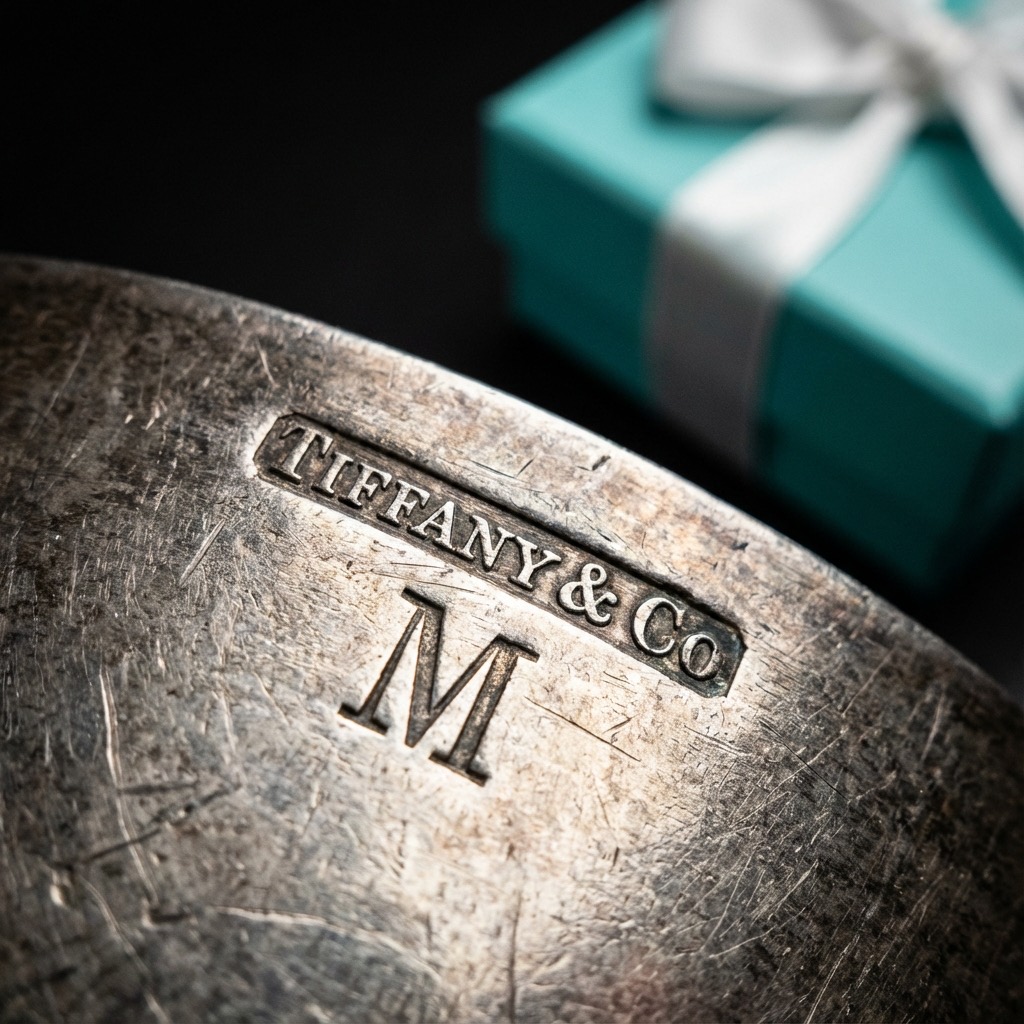
Pick up your loupe. Below or in the middle of the TIFFANY & Co. mark, you will find a solitary letter. This is the key.
1. 🌟 The “M” Mark (1869-1891) - The Golden Age
- Director: Edward C. Moore
- Feature: An Old English style M.
- Status: Highest Collectibility. Moore was the greatest Artistic Director in Tiffany’s history. It was during this period that Tiffany won the Grand Prix at the 1878 Paris Exposition and launched the famous “Japonisme” and “Saracenic” styles.
- Subtext: If you see this M, you might be holding a museum-quality piece.
2. The “T” Mark (1891-1902)
- Director: Charles L. Tiffany (The Founder)
- Feature: A simple Serif T.
- Context: After Moore passed away, the old founder personally took over. This period continued the glory of the M era.
3. The “C” Mark (1902-1907)
- Director: Charles T. Cook
- Feature: A Serif C.
- Context: The peak of Art Nouveau.
4. The “m” Mark (1907-1947) - The Modern Era
- Director: John C. Moore II (Edward C. Moore’s son)
- Feature: A lower case sans-serif/serif m.
- Context: Spanning Art Deco and Retro styles. Designs became more geometric and streamlined.
5. The “L” Mark (1947-1956 & 1956-1965)
A confusing era with two Directors sharing the initial L:
- 1947-1956: Louis deBebian Moore (Son of John C. Moore II). Usually a Serif capital L.
- 1956-1965: William T. Lusk (Great-grandson of the founder). Also a capital L.
🔢 Step 2: The Numbers Game
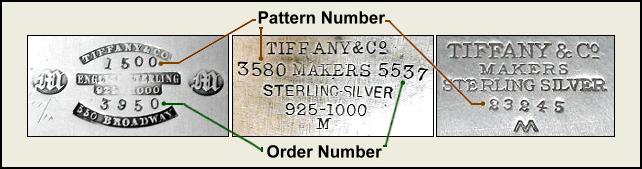
This is the most interesting and scientific part of Tiffany silver. Besides the letter, you will see two sets of numbers, usually flanking the mark.
Example:
12345 M 6789
- Left/Top Number (Pattern Number): The Design Date.
- This number indicates when the design drawing was filed.
- The larger the number, the newer the design.
- 1 is 1851. 10000 is approx 1890. 15000 is approx 1902.
- Right/Bottom Number (Order Number): The Production Batch.
- This tracks the specific factory order and is less useful for dating.
💡 Key Data: Pattern Number Reference Based on Tiffany Silver (Carpenter):
- 1 - 2349: 1851 - 1869
- 2350 - 9999: 1870 - 1889 (Early M period)
- 10000 - 15999: 1890 - 1904
- 16000+: Post-1905
💡 Why does this matter? If a piece has a low Pattern Number (e.g., designed in 1870) but the center letter is m (1907-1947), what does it mean? It means this is a “Classic Reissue”—made in the 1920s using an 1870 mold. This is crucial for valuation (Era-original pieces are usually worth more than reissues).
🏆 The Holy Grail: Martelé 950-1000
In the hierarchy of Tiffany collecting, one name sits above all rules: Martelé.
- Meaning: French for “Hammered”.
- Features:
- Handmade. No machine stamping.
- Pure Purity. Usually 950 or 958 silver, softer than sterling, to achieve a “melting butter” texture.
- Mark: Besides the Tiffany mark, it will bear the script
Martelé.
- Value: The pinnacle of American Art Nouveau. If you find one in a thrift store without realizing it, you missed a fortune.
📝 Summary: Quick Cheat Sheet
Next time you hold a piece of Tiffany silver, follow this order:
- Find the Letter:
- M (Old English) -> 1870-1890 (Most valuable, Art peaks)
- C -> Early 1900s (Art Nouveau)
- m (Lower case) -> 1907-1947 (Art Deco/Retro)
- Check the Numbers:
- Low Pattern No. + New Letter -> Reissue.
- Pattern No. matches Letter Era -> Original.
- Find Easter Eggs:
- Any
Martelé? AnySterling?
- Any
Tiffany silver is more than tableware; it is the epitome of the Gilded Age. It was with these M-marked spoons that American tycoons scooped their first taste of caviar and declared to Europe that the New World had arrived.