In the world of antique silver collecting, the golden rule is usually: “Hallmarks never lie.”
But in Germany, there was one place that broke this rule. A place where silversmiths were not only master craftsmen but also geniuses at weaving beautiful lies. That place is Hanau—a city that has given headaches to countless experts and joy to countless collectors.
Today, let’s decode these “Pseudo Marks” and learn to appreciate the artistry behind the disguise.
🏰 The City of Freedom
Hanau, located near Frankfurt, had a unique history. Since the 16th century, it served as a refuge for persecuted Walloon and Huguenot protestant craftsmen.
By the 19th century, while silversmiths in other German cities were bound by strict Guild regulations, Hanau was a “Free Trade City.” Its smiths were not required to adhere to unified purity laws or stamp official assay marks.
This led to two outcomes:
- Explosion of Craftsmanship: Unbound by rules, smiths created the most complex, luxurious pieces imaginable.
- Chaos of Hallmarks: With no legal requirement, smiths began inventing their own marks.
🎭 Why “Pseudo” Marks?
When novices hear the term “Pseudo Marks,” their first reaction is often: “Is it a fake?”
The answer is: No. It is “Retro.”
In the late 19th century, Europe was swept by a wave of Historicism. People were obsessed with the styles of the Rococo and Baroque periods from the 17th and 18th centuries.
The Hanau smiths thought: “If we are recreating a perfect Louis XV snuff box, stamping it with a modern ‘800’ or ‘Made in Germany’ would ruin the illusion.”
So, they created “Fantasy Marks”:
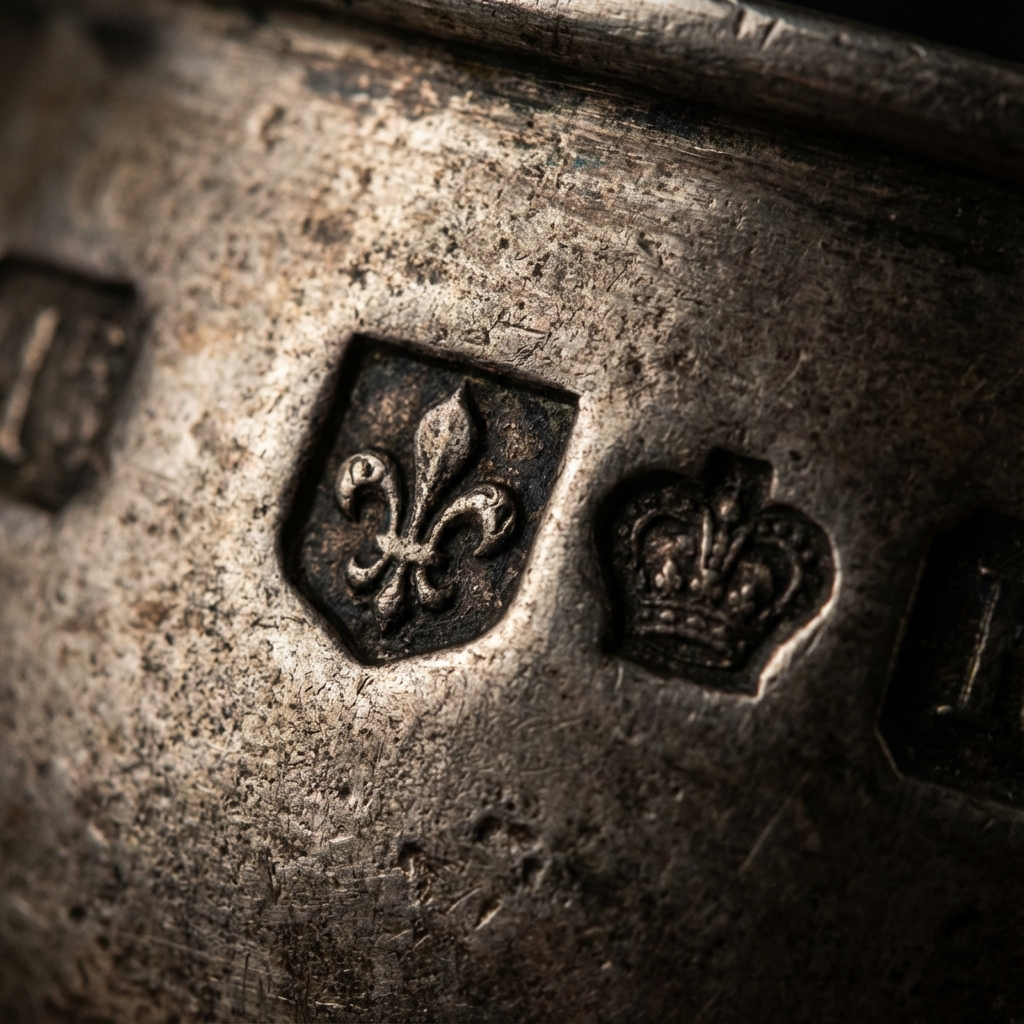
- They mimicked the French Fleur-de-lis, but drew it slightly differently.
- They copied the British Lion, but gave it a strange crown or pose.
- They used the initials of masters who had been dead for centuries.
The purpose was not fraud (selling base metal as silver), but Style Matching—making the marks blend seamlessly with the antique style of the piece.
Q’s Note: Hanau silver is famously high quality, often exceeding the 800 standard. These were luxury items for the elite.
🕵️♂️ The Big Three Makers
While there were hundreds of workshops, a few names command high prices at auctions.
1. Neresheimer (B. Neresheimer & Söhne)
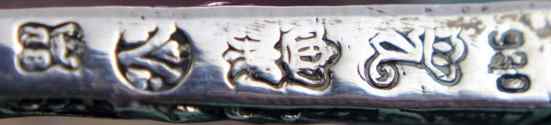
The uncrowned kings of Hanau. Known for massive, intricate works like Neffs (silver ships) and tankards.
- Marks: Look for the “GMA” monogram or the “AR” (Augustus Rex) cipher.
2. J.D. Schleissner & Söhne

The “Godfathers” of Hanau silver. The family owned a vast collection of antique molds, allowing for incredibly accurate reproductions.
- Marks: Often a combination of a Sickle and Crown, or an Eagle shield.
3. Storck & Sinsheimer
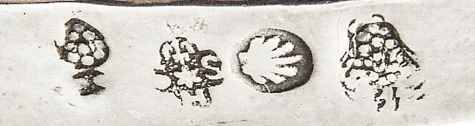
Popular in the American market.
- Marks: They preferred complex, coat-of-arms style shields, often hiding a subtle “S”.
🔍 Identification: How to Spot Hanau?
Identifying Hanau marks is an “advanced course” because there was no standard.
However, here are a few rules of thumb:
1. “Familiar yet Strange”
If you see a mark and think: “Is that French?” but then notice the bird is facing the wrong way or the helmet shape is off… -> 90% chance it’s Hanau.
2. “Safety in Numbers”
Standard hallmarks come in small groups (e.g., Moon + Crown + 800). Hanau marks like to “Party”. You will often see a string of 4, 5, or more stamps—crests, letters, animals—all lined up. -> 80% chance it’s Hanau.
3. Use Our Decoder
To help you identify these “beautiful liars,” I’ve updated the Hallmark Decoder on RareQuiste.
While we can’t list every variant, we have added a “Hanau Pseudo Marks” mode. If you see those ⚜️ Fleur-de-lis or 👑 Fancy Crowns on a piece that feels too new to be 18th century, check the “Hanau” entry.
💎 Value & Market
Is Hanau silver valuable?
Absolutely.
In the past, purists dismissed it as “imitation.” But today, as craftsmanship is re-evaluated, Hanau prices are soaring. A fine Neresheimer basket often sells for 3 to 5 times the price of a standard German 800 silver piece of the same weight.
You are buying not just silver, but a piece of art history that perfected the art of the “Beautiful Lie.”
📚 Further Reading
For a comprehensive list of Hanau marks and maker identifications, I highly recommend checking out: