In the Golden Age of American silver, if there was one rival that could stand toe-to-toe with Tiffany & Co., it had to be Gorham.
This factory from Rhode Island was not just a sidekick to Tiffany. In fact, in the mid-to-late 19th century, Gorham’s technical prowess and output often exceeded Tiffany’s. Even Mary Todd Lincoln specially commissioned Gorham for the White House silver service.
But for novice collectors, Gorham is also the biggest “trap” creator.
🦁 Step 1: Real or Fake “Birmingham”? (The Trademark)
Pick up a piece of Gorham silver, and the first thing you’ll usually see are these three symbols:
🦁 ⚓️ G > (Lion facing RIGHT) + (Anchor) + (Gothic G)
At this point, someone with a little knowledge of British hallmarks might exclaim: “Isn’t this British Birmingham (Anchor) Sterling (Lion)?”
Don’t get confused!
- Real British Birmingham: The Lion walks to the LEFT (Lion Passant), and the Anchor is just the Town Mark.
- American Gorham: The Lion walks to the RIGHT (Lion Passant), the Anchor represents Rhode Island (The Ocean State), and the G stands for Gorham.
This trademark has been used since the 1850s and is Gorham’s golden signature.
📜 Historical Context: Founded in 1831 by Jabez Gorham, the company truly took off under his son John Gorham. In 1852, John toured Europe, recruiting master craftsman George Wilkinson from England. Aided by the 1842 Tariff Act which blocked foreign silver imports, Gorham seized the opportunity to dominate the American market through mechanization.
🏺 Step 2: The Pictorial Date Codes (1868-1933)
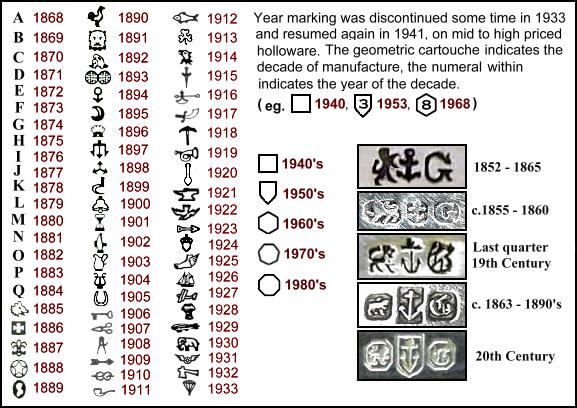
This is the most fascinating part. Starting in 1868, Gorham introduced a “Pictorial Totem” system.
⚠️ Important: These date codes are usually found on Holloware (tea sets, vases), and actually NOT used on Flatware (spoons, forks).
🔑 Decoding Classic Years:
- 1868 - 1884: Letters A - Q.
- 1885 - 1893: Various natural symbols (e.g., Wolf’s Head in 1885).
- 1894: ⚓️ Anchor in Shield —— A key milestone.
- 1900: 🚑 Swiss Cross (Sickle).
- 1916: 🗡 Dagger.
- 1918: ✈️ Biplane.
- 1929: ☁️/⚡️ Parachute —— Hinting at a “Soft Landing” during the Depression?
- 1933: 🔗 Hook —— The end of the pictorial system.
Post-1933: The Geometric Era
Marking was discontinued in 1933 and resumed in 1941, but the style changed drastically: Instead of pictorial objects, a Geometric Cartouche (frame) indicated the decade.
- 1940s: ⬜️ Square (e.g., Square with 8 inside = 1948)
- 1950s: ⬠ Pentagon
- 1960s: 🛑 Hexagon
- 1970s: ⚪️ Heptagon/Circle
- 1980s: 🖼 Octagon
🔨 Step 3: Martelé (The Hammered Series) — The Same Pedestal
Yes, Gorham has Martelé too. In fact, the very concept of Martelé was deeply defined by Gorham’s legendary designer William C. Codman (though Tiffany also had a series of the same name, the two are often compared).
- Gorham Martelé (9584 Purity):
- Even purer than Tiffany’s 950, reaching 95.84% (Britannia Standard).
- Feature: The ultimate “skin-like” texture. Every hammer mark is preserved on the surface, like Impressionist brushstrokes.
- Mark: It will be clearly marked with
Marteléand an Eagle symbol. - Rarity: Rarer than Tiffany’s Martelé. Every piece is a unique work of art.
🏛 Famous Patterns
If you can’t afford Martelé (who can?), Gorham’s mass-produced patterns are still highly collectible:
-
Chantilly (1895):
- Possibly the best-selling sterling flatware pattern in American history.
- Typical Rococo style, elegant and intricate.
- It is said that almost every American family heirloom collection contains a Chantilly spoon.
-
Versailles (1888):
- Extremely complex Baroque style. The handle features multiple nude cherubs and mythological figures.
- A favorite of many advanced collectors.
📝 Summary: How to ID Gorham?
- Check the Lion’s Direction: Lion facing Right + Anchor + G = American Gorham.
- Find the Totem: Below the three main marks, is there a strange little symbol (like a parachute, fish, or bird)? If so, congratulations, it’s an antique from 1868-1933.
- Check the Purity: While mostly Sterling (925), if it’s Coin (900), it’s an early work pre-1860; if it’s Martelé (958), get ready to be rich.
Gorham is like a curious old urchin. He engraved the mood of that year—whether it was the longing for flight (Biplane) or the fear of crisis (Parachute)—onto the back of every spoon.