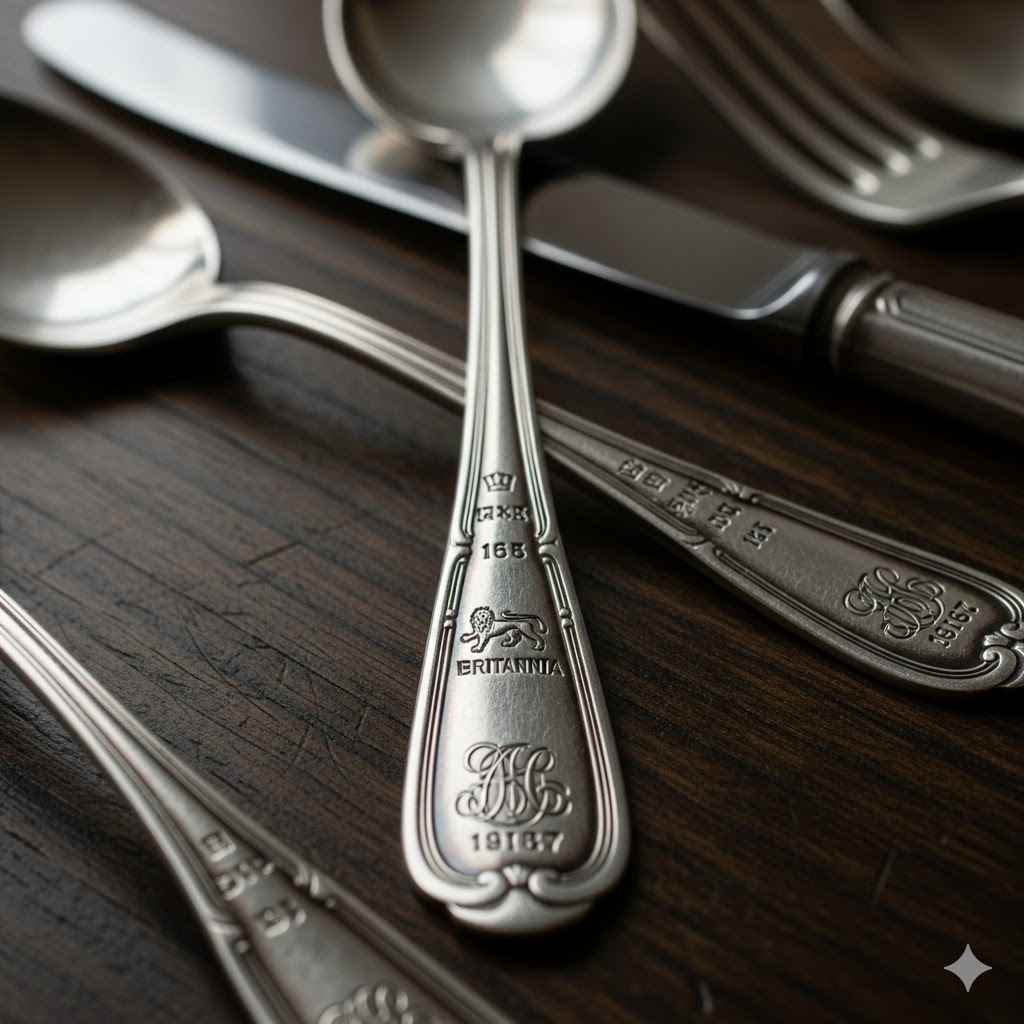
If British silver hallmarks are a set of rigorous laws, then German silver hallmarks are a history of “From Chaos to Unity”.
Before 1888, various German city-states (Hamburg, Berlin, Augsburg) had their own marks (Loth standard). But after 1888, the German Empire implemented a unified hallmark system. As long as you remember the “Crescent and Crown”, you can identify 90% of antique German silver.
👑 1. Imperial Mark (Reichsmark)
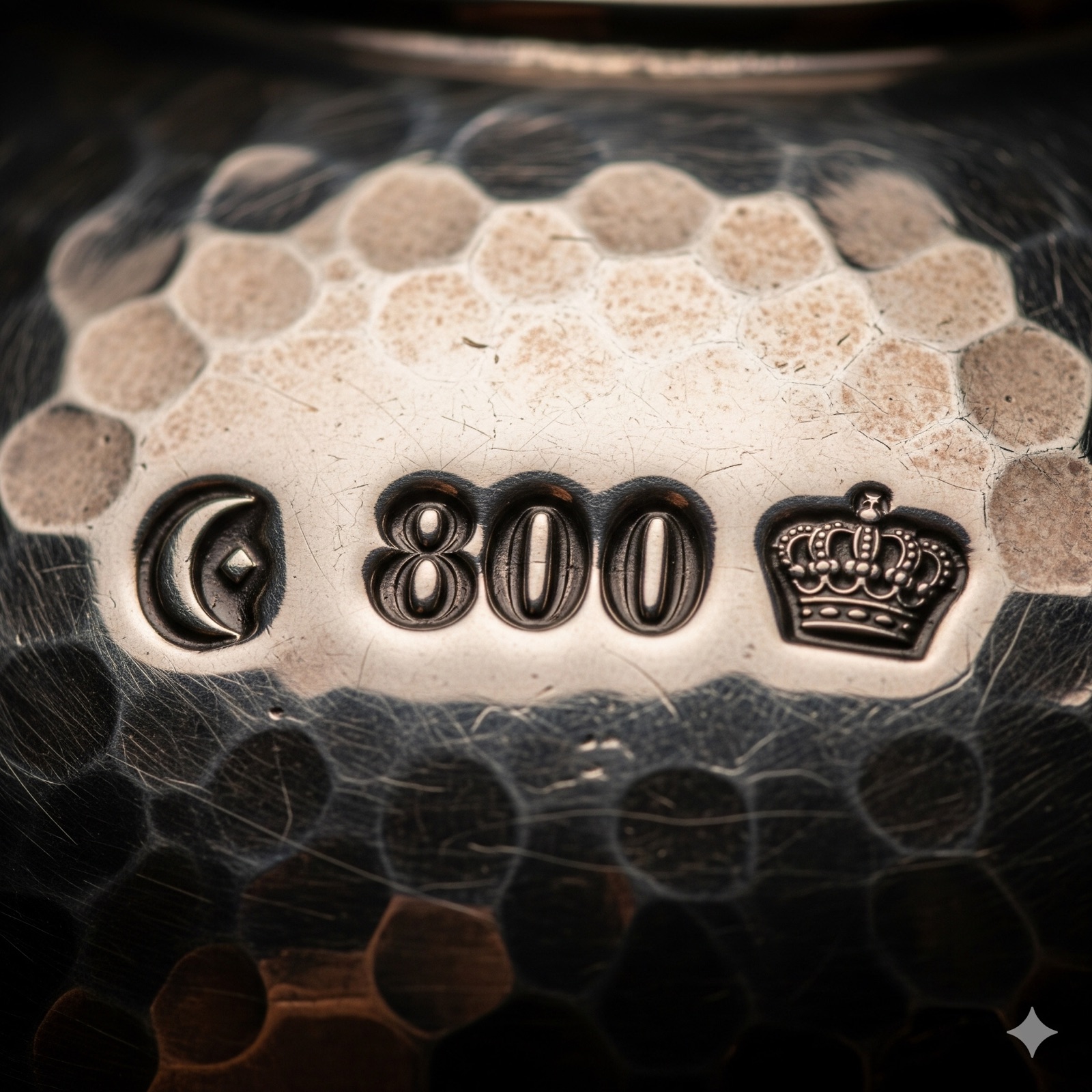
If you see these two symbols combined on a piece of silver, it is guaranteed to be German-made after 1888. These are the legally required National Marks:
- 🌙 Crescent Moon (Halbmond): Facing right, representing the silver material.
- 👑 Imperial Crown (Reichskrone): Represents the German Empire.
These two symbols usually appear side by side, followed closely by the purity number.
Note: For gold items, a “Sun and Crown” mark is used.
⚖️ 2. Purity: The Rule of 800
Unlike the British, who strictly adhered to “925 Sterling”, Germans were more pragmatic. The minimum national standard established in 1884 was 800/1000.
- 800: The most common. It has high hardness, making it suitable for large tea sets, candlesticks, and pierced fruit baskets. Because of the higher copper content, antique German silver often oxidizes to a unique dark charcoal-grey color.
- 830 / 835: Also relatively common, mostly used for flatware and daily items.
- 900 / 925 / 935: Although they exist, they are rarer. 925 is usually for export or modern jewelry; 935 is sometimes seen on high-end portable items like cigarette cases or vanity compacts.
Q’s Collection View: Don’t look down on it just because “800” has lower silver content. The craftsmanship of German silversmiths in Pierced Work and Repoussé (Figure Relief) is often more complex and decorative than British silverware of the same period.
🦊 3. Hanau Silver: The Beautiful “Liar”
In German silver collecting, there is a special category called Hanau Silver, which is a threshold that advanced collectors must cross.
Hanau was a “Free Trade City” where there were no guild restrictions or official quality supervision. Therefore, a group of top silversmiths gathered there (such as Neresheimer, Schleissner, Storck & Sinsheimer).
- Retro Frenzy: Hanau silversmiths were masters of imitation. They obsessively copied styles from the 16th-18th centuries, such as French Rococo or Dutch antique silver.
- Pseudo-Hallmarks: Because there was no official regulation, they created their own system of “Fantasy Marks”. You might see marks that look like a French fleur-de-lis, a British lion, or an old city crest, but are slightly “off”.
- Purpose: This was usually not intended to deceive, but to make the silver piece look more “authentic” to the historical style it was imitating (Style Matching).
- Difficulty in Identification: The Hanau pseudo-mark system is extremely complex, with specialized books dedicated to studying it (e.g., Scheffler). Once you see a cluster of messy, familiar-looking but unidentifiable marks, it is likely Hanau made.
Value: Although the marks are “fake”, the craftsmanship of Hanau silver is excellent (often better than many standard 800 silver pieces), and its artistic value is extremely high. In the auction market, it often fetches higher prices than regular silverware.
🏭 4. Famous Brands & Makers
Besides the Hanau workshops, there are several famous orthodox German silver factories:
- Koch & Bergfeld: A top silver factory in Bremen (est. 1829), famous for Art Nouveau (Jugendstil) flatware.
- Wilkens & Söhne: The oldest silver factory in Bremen, known for exquisite pierced dessert servers and modern designs.
- Lutz & Weiss: From Pforzheim (the Jewelry Capital of Germany), often making exquisite small items and jewelry.
- Gebrüder Deyhle: Known for high-quality silver-plated and sterling silverware.
🧐 Summary
Next time you pick up a piece of silver in an antique shop:
- Look for 800 -> Confirms it is silver.
- Look for 🌙👑 -> Confirms it is German (post-1888).
- If you can’t find the moon and crown, but see a bunch of strange gothic letters and symbols -> Congratulations, it might be the more valuable Hanau silver!